Albuquerque Housing Market Report: April 2026 — Median Price Holds at $385,000 as Inventory Builds
Albuquerque Housing Market Report: April 2026 — Is the Spring Surge Finally Cooling Off?
For the better part of the last eighteen months, Albuquerque's housing market has operated on a single gear: forward. Prices climbed, inventory stayed thin, and buyers who hesitated on a listing in Nob Hill or the Northeast Heights often found themselves starting over. April 2026 tells a slightly different story — not a reversal, but a recalibration. The median home price settled at $385,000, a 3.5% increase year-over-year, but the pace of appreciation has clearly downshifted from the 6–8% annual gains the metro posted in 2024 and early 2025. Active listings have risen to 3,200 homes, the highest count since October 2024, and the average home is now sitting on the market for 34 days before going under contract — up from 26 days in February.
This is not a buyer's market. But it is no longer the frenzied seller's market that had buyers waiving inspections on casitas off Montgomery Boulevard. The Albuquerque real estate market in April 2026 is best described as a market in transition — one where preparation, pricing discipline, and local knowledge matter more than they have in years.
Albuquerque Housing Inventory: Supply Is Finally Catching Up
The single most important shift in the April 2026 albuquerque housing market is what is happening on the supply side. Active listings reached 3,200, representing a month-over-month increase of roughly 11% from March's count near 2,880, and a year-over-year increase of approximately 28% from April 2025's deeply constrained 2,500-unit figure. Months of supply now stands at 2.8 months, up from 2.1 months at the start of the year.
To put that in context: a balanced market is generally defined as 4–6 months of supply. At 2.8 months, Albuquerque remains firmly in seller's territory, but the gap is narrowing. New listings in April came in at approximately 1,050, while closed sales tracked around 740 — a spread that, if sustained, will continue pushing active inventory higher through May and June.
What Is Driving the Inventory Increase?
Several forces are at work simultaneously. First, the lock-in effect that kept would-be sellers glued to their 3% mortgages is beginning to loosen. Homeowners who bought in 2019 and 2020 and have accumulated substantial equity are increasingly willing to trade up, particularly as they weigh life changes — retirements, job relocations, and growing families. Second, new construction completions in Rio Rancho's Mariposa and Lomas Encantadas subdivisions have added meaningful supply to the sub-$350,000 tier. Third, a handful of higher-priced listings in Corrales and High Desert that sat through winter are now re-entering the market with price reductions, contributing to the active count without representing genuine new supply.
The net effect is a market where buyers have more choices than at any point in the last 18 months — but where well-priced homes in desirable locations are still moving quickly.
Albuquerque Home Prices by Tier: Where Competition Remains Fierce
The $385,000 median masks significant variation across price tiers, and understanding where the market is tight versus where it has softened is essential for both buyers and sellers.
$200,000–$300,000: This tier remains the most competitive segment in the Albuquerque real estate market. Inventory is critically thin, with many of these homes — concentrated in the South Valley, Kirtland area, and older Northeast Heights neighborhoods east of Wyoming Boulevard — receiving multiple offers within the first weekend. The average price per square foot in this tier has climbed to approximately $178, up from $165 a year ago. First-time buyers and investors are competing for the same small pool of available homes.
$300,000–$400,000: The sweet spot of the market. This range, which captures the bulk of activity in Taylor Ranch, the Mid-Heights, and Rio Rancho's newer subdivisions, accounts for roughly 38% of all closed sales in April. Homes are moving in an average of 28 days, and list-to-sale ratios in this tier are running at 99.2% — meaning buyers are getting almost no discount from asking price. Sellers here are still firmly in control.
$400,000–$500,000: This tier is where the cooling is most visible. Days on market have stretched to approximately 38 days, and the list-to-sale ratio has slipped to around 97.4%. Buyers in this range, which covers much of Nob Hill's renovated bungalow market and the newer construction along the Paseo del Norte corridor, now have genuine negotiating room for the first time since 2022.
$500,000 and above: The luxury and semi-luxury segment continues to operate on its own timeline. Corrales horse properties, High Desert custom homes with Sandia views, and the handful of estate properties along Rio Grande Boulevard are averaging 52 days on market. Price reductions are more common here than anywhere else in the metro, and buyers with patience and financing in place are finding real value.
“"The Albuquerque market in April 2026 is not one market — it is four, layered by price tier. A buyer competing for a $280,000 home in the Northeast Heights is operating in a completely different environment than someone considering a $650,000 property in High Desert."
Days on Market in Albuquerque: Speed Is Slowing, But Not Stopping
The 34-day average days on market represents a meaningful deceleration from February's 26-day figure and January's 29 days. However, it is important to read this number carefully. The metro-wide average is being pulled upward by the slower-moving luxury segment and by a cohort of overpriced listings that are sitting without offers and distorting the data.
For homes priced correctly in the $300,000–$425,000 range, the effective days on market is closer to 18–22 days. A well-presented three-bedroom on a quiet street off Comanche Road or near Osuna in the Northeast Heights is still generating showing traffic within 48 hours and offers by the end of the first weekend.
The strategic implication for buyers: the days of writing an offer sight-unseen on a Thursday afternoon to beat Friday's open house are not entirely gone, but they are less common than a year ago. Buyers now have the luxury of a second showing in many cases — and in the $400,000-plus tier, they should absolutely use it.
Albuquerque Neighborhood-by-Neighborhood Breakdown: April 2026
The following neighborhood data reflects closed sales and active listing trends for April 2026.
Northeast Heights
Median Price: $338,000 | Average DOM: 21 days | YoY Price Change: +4.8%
The Northeast Heights remains Albuquerque's most active submarket by transaction volume. The combination of established school districts, proximity to Kirtland AFB via Gibson Boulevard, and relatively accessible price points continues to drive demand. The stretch between Candelaria and Montgomery, particularly west of Tramway, is seeing the heaviest activity. Inventory has ticked up slightly but remains below 1.5 months of supply in most zip codes.
Nob Hill
Median Price: $412,000 | Average DOM: 29 days | YoY Price Change: +3.2%
Nob Hill's walkable, arts-forward character continues to attract remote workers and UNM-adjacent buyers. The Nob Hill Business District along Central Avenue is driving foot traffic that translates to residential interest in the surrounding blocks. Bungalows and adobes in the $375,000–$450,000 range are moving reasonably well; anything requiring significant renovation is sitting longer as buyers grow more cost-conscious about post-purchase improvement budgets.
North Valley
Median Price: $447,000 | Average DOM: 38 days | YoY Price Change: +2.9%
The North Valley's appeal — acequia-laced lots, mature bosque landscapes, and the agricultural character along Rio Grande Boulevard — remains unique in the metro. But this is a market of patience. Properties here are idiosyncratic, and the buyer pool is narrower. April saw several listings that had been sitting since January finally close after price adjustments averaging 4–5% below original list.
Rio Rancho
Median Price: $318,000 | Average DOM: 24 days | YoY Price Change: +5.1%
Rio Rancho continues to outperform the broader metro on year-over-year appreciation, driven by new construction, Intel's sustained local employment base, and buyers priced out of Albuquerque proper. The Mariposa master-planned community and the area around Northern Boulevard and Unser are particularly active. At 5.1% year-over-year price growth, Rio Rancho is the strongest-appreciating submarket in the greater metro area.
Corrales
Median Price: $598,000 | Average DOM: 54 days | YoY Price Change: +1.7%
Corrales operates as a lifestyle market more than a volume market. Horse properties and large-lot adobe compounds along Corrales Road appeal to a specific buyer who is rarely in a hurry. April's data reflects a market that is healthy but deliberate — sellers who price aggressively are finding buyers; those who price to the peak of 2024 are waiting.
High Desert
Median Price: $672,000 | Average DOM: 58 days | YoY Price Change: +1.4%
High Desert, the master-planned community tucked against the Sandia foothills east of Tramway, saw modest activity in April. The views from homes along Juniper Hill Road and Eagle Rock Loop remain among the most compelling in the city, but at this price point, buyers are thorough and timelines are long. The YoY appreciation of 1.4% reflects the broader softening at the top of the market.
Downtown Albuquerque / EDo (East Downtown)
Median Price: $295,000 | Average DOM: 33 days | YoY Price Change: +3.8%
The Downtown and East Downtown corridor — anchored by the Kimo Theatre, the Rail Yards redevelopment, and the growing restaurant scene along Gold Avenue — continues its slow but steady residential evolution. Condos and townhomes are the dominant product type, and the buyer profile skews younger and more urban-oriented. The film industry's continued presence in Albuquerque (multiple productions were active at ABQ Studios and Garson Studios through Q1 2026) has added a small but real cohort of production professionals to the downtown rental and ownership market.
Taylor Ranch
Median Price: $352,000 | Average DOM: 26 days | YoY Price Change: +4.1%
Taylor Ranch on Albuquerque's West Side remains a reliable, high-velocity submarket. Families drawn to the area's newer construction stock, access to Paseo del Norte, and proximity to the Cottonwood Mall corridor are keeping demand steady. The neighborhood's relative affordability compared to the Northeast Heights at similar square footage is a persistent selling point.
What April 2026 Means for Albuquerque Buyers and Sellers
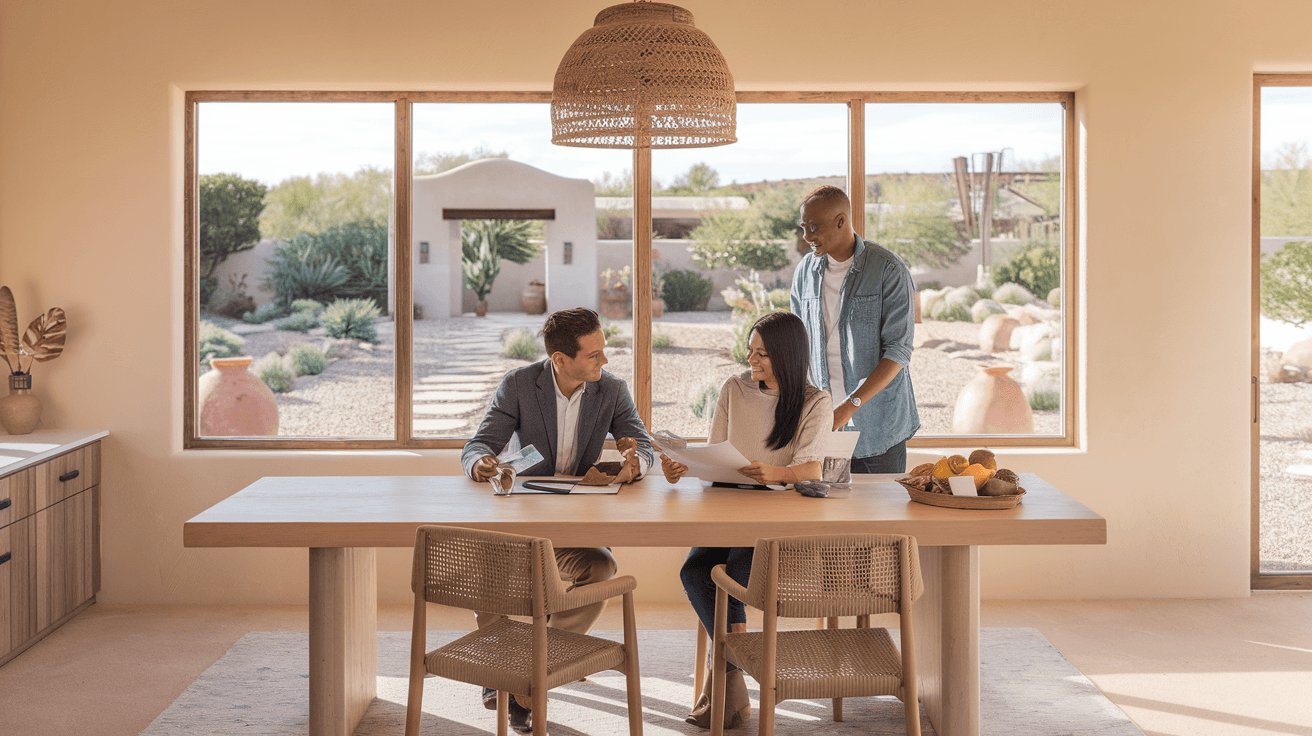
If You Are Selling in Albuquerque Right Now
The window of effortless selling — where any home at any price found a buyer in a week — has passed. That does not mean the market is working against you. It means pricing strategy has returned as the single most important variable in your outcome.
Homes priced at or slightly below current comparable sales are still generating strong offer activity. Homes priced to the optimistic end of their range are sitting 45, 60, 90 days and ultimately selling for less than a correctly priced listing would have fetched on day one. In the current Albuquerque real estate market, the first two weeks on the market remain your most powerful window. If you are not generating showing activity in the first ten days, the price is the problem.
Presentation matters more than it did two years ago. Buyers who now have the option of seeing multiple homes before making a decision are making comparative judgments. Updated kitchens, clean landscaping, and move-in-ready condition are no longer nice-to-haves — they are table stakes for commanding top-of-range pricing.
If You Are Buying in Albuquerque Right Now
April 2026 offers buyers the most favorable conditions since early 2023, and that is worth recognizing. You are unlikely to find a market where you can lowball a well-priced home in the Northeast Heights or Taylor Ranch — that is not this market. But you can negotiate on inspection items, seller concessions toward closing costs, and timeline flexibility in ways that were simply not possible eighteen months ago.
Get pre-approved, not just pre-qualified. In the $300,000–$400,000 tier where competition remains real, a fully underwritten pre-approval letter from a local lender carries weight. Sellers in this market have been burned by contingent offers falling through, and demonstrating financing certainty moves you to the front of the line.
For buyers targeting the $400,000-plus range, this is genuinely the best moment in several years to negotiate. Sellers in this tier have adjusted their expectations, and a disciplined offer with a reasonable inspection contingency is no longer an automatic non-starter.
“"Buyers who were beaten back in 2024 and early 2025 should know: the same neighborhoods are still available, prices have not corrected, but the process has normalized. You have time to think. Use it."
Albuquerque Real Estate Outlook: What to Expect in May and June 2026
Historically, May and June are Albuquerque's highest-volume transaction months — families want to close before the school year ends, and the combination of warm weather and longer days drives listing activity. That seasonal pattern should hold in 2026, but with a few important caveats.
Interest rate environment: The Federal Reserve held rates steady at its March 2026 meeting, and current 30-year fixed mortgage rates are hovering in the 6.6–6.9% range for well-qualified buyers. There is no credible near-term catalyst for a significant rate reduction, which means affordability constraints will continue to shape demand, particularly in the sub-$350,000 tier where monthly payment sensitivity is highest.
Local employment: Kirtland AFB, Sandia National Laboratories, and Intel's Rio Rancho operations remain the three pillars of Albuquerque's economic stability, and all three appear steady heading into summer. UNM's enrollment trends and the university's ongoing facilities investment continue to support the Nob Hill and University Heights submarkets. The film industry, which contributed an estimated $800 million to the New Mexico economy in 2025, remains an underappreciated driver of residential demand in the Downtown and East Side corridors.
Inventory trajectory: If new listing volume continues at April's pace, active inventory could approach 3,500–3,700 units by late June — a level not seen since 2022. That would represent a genuine shift in negotiating dynamics, particularly for the move-up and luxury segments. Watch the months-of-supply figure closely: if it crosses 3.5 months, expect to see list-to-sale ratios slip further and days on market extend into the mid-40s metro-wide.
The most likely scenario for May and June: modest price appreciation of 1–2% from April's $385,000 median, continued inventory growth, and a market that increasingly rewards buyers who are patient and sellers who are realistic.
Key Takeaways: Albuquerque Housing Market April 2026
- •Median price held at $385,000, up 3.5% year-over-year, but the pace of appreciation is the slowest since mid-2023 — a signal that the market is finding equilibrium rather than continuing to accelerate.
- •Active inventory reached 3,200 homes at 2.8 months of supply, the highest inventory level in 18 months — buyers have more choices, but this remains a seller's market by any conventional definition.
- •Rio Rancho led all submarkets with 5.1% year-over-year price appreciation, driven by new construction completions and sustained Intel employment; it remains the best value proposition in the greater metro for buyers prioritizing square footage and newer construction.
- •The $300,000–$400,000 tier is the most competitive segment, with list-to-sale ratios of 99.2% and average days on market of 28 days — buyers in this range should be prepared to move decisively and come in at or near asking price on well-presented homes.
- •Days on market at 34 days metro-wide represents a 31% increase from February's pace, and the trend is toward further normalization — sellers who price to 2024 peak comparables rather than current April 2026 data are the ones sitting on the market and eventually reducing.
Want more insider intel?
Subscribe to get market updates and new articles delivered to your inbox.