
Living in Corrales NM in 2026: Horse Properties, Orchard Roads, and What Buyers Pay for Rural Charm Just 20 Minutes From Albuquerque
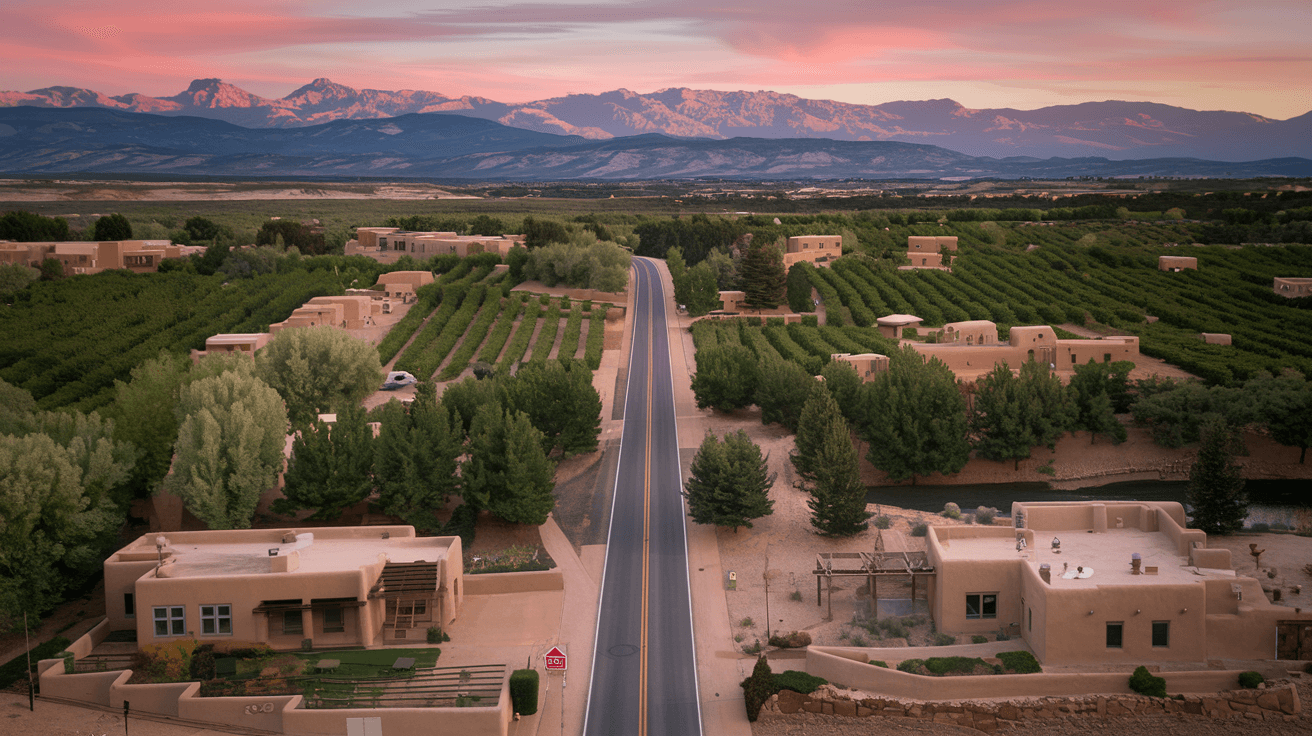
There is a moment, usually somewhere along Corrales Road between the old Wagner Farms property and the stretch where the apple orchards still line the acequia, when you realize you are not in Albuquerque anymore. The air smells different. The pace drops. Someone on a horse is waiting at an intersection, and nobody is honking. That is living in Corrales NM, and once you experience it, the $385,000 metro median starts to feel like a different universe entirely.
Corrales sits in Sandoval County, tucked between the Rio Grande bosque to the east and the West Mesa to the west, with the Sandia Mountains framing the entire eastern skyline in that particular shade of watermelon pink at sunset. It is technically a village, and it takes that designation seriously. There are no big-box stores here, no chain restaurants along the main drag, and the speed limit feels more like a suggestion that residents actually follow.
For buyers considering Corrales New Mexico homes for sale in 2026, the question is never really "is this a nice place to live?" That answer is obvious the first time you drive through. The real questions are about price, what you actually get, how the schools work, and whether the rural lifestyle fits your life. This post answers all of that honestly.
Living in Corrales NM: What the Village Actually Feels Like Day to Day
Corrales Road is the spine of the village, a two-lane stretch that runs roughly north-south and connects everything worth knowing about. You will pass the Casa Vieja building that has anchored the community for generations, the Corrales Winery where locals grab bottles on a Saturday afternoon, and the handful of art galleries and small businesses that give the village its character without turning it into a tourist trap.
The bosque trail system along the Rio Grande is the kind of amenity that does not show up on a listing sheet but absolutely drives buying decisions. Residents walk it with dogs in the morning, ride horses along the river corridor, and mountain bike through the cottonwoods in fall when the leaves turn gold and the light does something genuinely cinematic. If you have only experienced the bosque from the Paseo del Norte bridge, walking it from Corrales is a different experience entirely.
Grocery runs and serious errands take you south toward Alameda or over to Rio Rancho, which is close enough not to be a problem. The Walmart on Unser or the Sprouts off Coors handles the practical side of life. But the rhythm of Corrales itself, the Saturday farmers market, the community ditch riders maintaining the acequia system, the unofficial rule that everyone waves at everyone on Corrales Road, that part does not require leaving the village at all.
“"Corrales is one of the few places in the metro where you can genuinely hear nothing at night except the acequia running and maybe a neighbor's rooster. That silence has a price tag, and in 2026, buyers are absolutely paying it."
Insider tip: The stretch of Loma Larga Road and the surrounding network of dirt easement roads in the northern part of the village is where some of the most private horse properties hide. These rarely hit the MLS with big marketing budgets because longtime locals often know about them before they list publicly. If you are serious about Corrales, you want an agent who is already talking to those sellers.
Corrales NM Real Estate 2026: What the Numbers Actually Mean
The Corrales NM real estate 2026 market is operating at a median price point of around $680,000, which is nearly double the broader Albuquerque metro median of $385,000. That gap is not a fluke. It reflects what buyers are actually purchasing: larger lots measured in acres rather than square feet, agricultural water rights tied to the acequia system, horse facilities ranging from basic two-stall setups to full equestrian compounds, and the kind of privacy that simply does not exist in established Albuquerque neighborhoods like Four Hills or the North Valley.
The metro market overall is sitting at 31 days on market with about 4.1 months of inventory and a list-to-sale ratio of 97.8%, which tells you that well-priced properties across Albuquerque are still moving and sellers are not giving away the farm, figuratively speaking. Corrales tends to run slightly longer on market because the buyer pool is smaller and more specific, but correctly priced properties with genuine horse facilities or acreage still generate real competition.
What Different Price Ranges Get You in Corrales
Understanding Corrales New Mexico homes for sale requires thinking in tiers, because the village offers a surprisingly wide range of product.
- •$450,000 to $600,000 typically gets you a well-maintained adobe or stucco home on a half-acre to one-acre lot, often without dedicated horse facilities but with the land and zoning to add them, usually in the central or southern parts of the village closer to Corrales Road
- •$600,000 to $850,000 is where most of the classic Corrales properties live: two to three acres, a barn or at least a loafing shed, mature cottonwood trees, and an older adobe that has been updated or a newer build that respects the village aesthetic
- •$850,000 to $1.2 million opens up the serious equestrian properties, the ones with irrigated pasture, multiple stalls, arenas, and the kind of square footage that still feels grounded rather than pretentious
- •Above $1.2 million represents the estate tier, custom builds with mountain views from every window, guest casitas, professional-grade horse facilities, and acreage that gives neighbors enough buffer you might never see them
One thing buyers consistently underestimate is the value of acequia water rights. Properties with active acequia irrigation rights have a real agricultural asset attached to them. Those rights allow owners to irrigate orchards, pasture, and gardens from the historic ditch system that has been running through Corrales since long before New Mexico was a state. Not every property has them, and when one does, it is worth understanding what you are buying.
Horse Properties in Corrales NM: What to Look For and What to Watch Out For
Corrales has a legitimate claim to being the most horse-friendly community in the Albuquerque metro, and that is not marketing language. The village zoning accommodates livestock on most properties, the trail system connects directly to the bosque for riding, and the culture genuinely supports equestrian life in a way that newer suburban communities simply cannot replicate.
That said, buying a horse property in Corrales requires a different inspection checklist than buying a standard residential home.
- •Well water and irrigation: Many Corrales properties rely on private wells for domestic use and acequia water for irrigation. Both systems need evaluation. Well depth, pump age, and water quality testing are non-negotiable due diligence items.
- •Barn and outbuilding condition: Older adobe and wood-frame barns can look charming and hide significant structural or pest issues. A thorough inspection by someone familiar with agricultural structures is worth the extra cost.
- •Pasture condition and soil: Years of heavy horse use can compact soil and create drainage problems. Walk the pasture after a rain if you can.
- •Zoning and livestock limits: Corrales zoning is generally permissive, but parcel size and specific zone designations affect how many animals you can keep. Verify this before you fall in love with a property.
- •Flood plain status: Properties near the bosque and the river corridor may carry FEMA flood zone designations that affect insurance costs significantly. This is not a dealbreaker, but it needs to be priced into your decision.
“"The buyers who do best in Corrales are the ones who treat the land itself as the primary asset and the house as secondary. The acreage, the water rights, the mature trees, those are what you cannot replicate anywhere else in the metro."
Corrales Schools and Community Infrastructure
This is the section where Corrales gets a little complicated, and buyers deserve a straight answer rather than a vague "check with the district" deflection.
Corrales sits in Sandoval County, which means the primary elementary school is Corrales Elementary, a well-regarded school with the small-community feel you would expect from the village itself. After elementary, students feed into the Rio Rancho school system rather than Albuquerque Public Schools. That means middle and high school options are through Rio Rancho, which has strong academic programs and newer facilities, but it is a different experience than if you were buying in the North Valley or Ventana Ranch.
For families with younger children, Corrales Elementary is genuinely one of the selling points of the village. Class sizes are manageable, parent involvement is high, and the school reflects the community character in a way that larger district schools rarely do.
On the infrastructure side, a few practical realities of living in Corrales NM are worth knowing:
- •Most of the village is on septic systems rather than municipal sewer. Septic inspection and pumping history are important parts of due diligence.
- •Internet service has improved significantly but is not uniform across the village. If remote work is part of your life, confirm service availability at the specific address before closing.
- •Fire protection is handled by the Corrales Volunteer Fire Department, which is well-equipped and responsive but covers a large geographic area. Some insurance carriers factor this into rates for rural properties.
- •The village does not have a hospital or urgent care, but Presbyterian Rust Medical Center in Rio Rancho is about 15 minutes away, and the full range of Albuquerque medical facilities are reachable in 20 to 25 minutes.
Why Buyers Keep Choosing Corrales Over Other ABQ-Area Rural Options
Buyers considering rural or semi-rural properties in the metro area typically look at a few alternatives alongside Corrales: the East Mountains communities like Tijeras and Edgewood, the South Valley along the Rio Grande, and parts of the far North Valley near Alameda. Each has its appeal, but Corrales holds a specific combination of advantages that keeps it competitive despite the price premium.
The 20-minute commute to Albuquerque is real. Via Corrales Road to Alameda Boulevard to I-25, you are at the Paseo del Norte interchange in under 20 minutes on a normal morning. Compare that to Tijeras or Cedar Crest, where you are looking at 35 to 45 minutes minimum and mountain weather as a variable. The East Mountains are beautiful, but Corrales buyers typically do not want to trade the bosque and the flat riding terrain for elevation and pine trees.
The village governance model also matters more than buyers initially realize. Corrales has fought hard over decades to maintain its agricultural character against development pressure from surrounding Rio Rancho growth. The village council has historically been protective of the acequia system, the open space, and the low-density zoning that makes Corrales what it is. That is not guaranteed forever, but it is a meaningful structural difference from unincorporated areas that can be rezoned or annexed more easily.
For buyers who are ready to take the next step with Corrales NM real estate in 2026, the Taylor Team at Berkshire Hathaway HomeServices knows this village in a way that only comes from years of working here. Reach out and we will walk you through what is actually available, what is priced right, and what the sellers in that northern network of roads might be thinking about before they ever call a sign company.
The Honest Case for Paying the Corrales Premium
Spending $680,000 in Corrales when the metro median sits at $385,000 is a deliberate choice, not a compromise. Buyers who end up here are not people who could not find something in the North Valley or Rio Rancho. They are people who drove Corrales Road once, walked the bosque, stood in a pasture under the cottonwoods, and decided that what they felt there was worth paying for.
The Corrales NM real estate market in 2026 is competitive enough that waiting for prices to drop significantly is probably not a winning strategy. The village is geographically constrained, the zoning is protective, and the number of people who want exactly what Corrales offers keeps growing while the supply of genuine horse properties with water rights stays essentially fixed.
What you are buying in Corrales is not just a house. It is a specific quality of morning, a particular relationship between land and water and sky that the Rio Grande has been creating in this valley for longer than anyone can remember. For the right buyer, that is not a premium at all. It is exactly what they came to New Mexico to find.
Want more insider intel?
Subscribe to get market updates and new articles delivered to your inbox.