Moving to Albuquerque: The Complete Relocation Guide
Every year, a few thousand people from Denver, Austin, and Phoenix look at their rent statements or their property tax bills and start Googling. They end up on a late-night YouTube rabbit hole of sunset videos over the Rio Grande, and somewhere around 1 a.m. they type "moving to Albuquerque" into a search bar and wonder if they are crazy for considering it. They are not crazy. They are early.
Albuquerque is having a moment that is less about hype and more about math. When a two-bedroom in Austin runs $2,400 a month and a comparable house in Albuquerque's Northeast Heights sells for $320,000 with a yard and a mountain view, the spreadsheet starts doing the convincing. But cost of living is only part of the story. The people who stay here long term stay because of the green chile, the 310 sunny days a year, the way the Sandia Mountains turn the color of a ripe watermelon at sunset, and a culture that is genuinely unlike anywhere else in the country. This guide is for the people who are serious about making the move and want the real picture — not the chamber of commerce version, but the version a local agent would tell you over coffee at Flying Star on Menaul.
The Cost of Living Reality Check
Let's start with the number most people want first. The median home price in Albuquerque metro as of early 2026 is approximately $348,000. In Denver's metro, that number is closer to $575,000. In Austin, you are pushing $500,000 for anything with a functioning kitchen. Phoenix has crept up close to $450,000 after the pandemic surge. Albuquerque is not cheap the way it was in 2018, but relative to every major Sun Belt city it relocated people are coming from, it remains a serious value.
Rent follows the same pattern. A nice two-bedroom apartment in the Northeast Heights or near UNM runs $1,200 to $1,600 per month. A three-bedroom house with a garage in the Four Hills area, close to Kirtland AFB, often rents for $1,600 to $2,000. Groceries, utilities, and gas run slightly below national average. New Mexico's state income tax tops out at 5.9 percent, which is not nothing, but property taxes are genuinely low — effective rates typically run around 0.7 to 0.8 percent of assessed value, which means that $350,000 house costs you roughly $2,500 to $2,800 per year in property taxes. In Texas, that same house might cost you three times that.
Healthcare costs are a real consideration. New Mexico's healthcare system is anchored by Presbyterian Healthcare Services, the dominant regional health network with hospitals and clinics throughout the metro, and Lovelace Health System, which operates several major Albuquerque facilities. The University of New Mexico Health Sciences Center is a major teaching hospital with strong specialty care. For routine care, costs are generally in line with national averages. For specialized care, the options are solid but not as dense as Phoenix or Denver.
Major Employers: Why People Actually Move Here
Albuquerque is not a retirement destination or a lifestyle suburb. It is a working city built around a handful of major employers that generate serious economic stability. Understanding who drives this economy matters if you are evaluating your own job prospects or a partner's.
Sandia National Laboratories is the city's crown jewel employer. Operated by Honeywell and funded by the Department of Energy, Sandia employs roughly 14,000 people — scientists, engineers, security professionals, and support staff — on a campus that sprawls along the eastern edge of Kirtland Air Force Base. The salaries are federal-scale, the benefits are exceptional, and the security clearance pipeline creates a steady flow of highly paid workers into the Albuquerque housing market. If you are in aerospace, defense technology, nuclear science, or advanced computing, there is meaningful work here.
Kirtland Air Force Base anchors the southeast corner of the city and is home to roughly 25,000 military and civilian personnel between active duty, Reserve, Guard, and contractor employees. The base hosts the Air Force Research Laboratory and multiple weapons programs. Military families PCSing to Kirtland bring a constant, predictable demand into the rental and purchase market.
Intel Corporation operates its massive fabrication facility in Rio Rancho, about 15 miles northwest of downtown Albuquerque via Highway 528. Intel is Rio Rancho's largest private employer, with operations that have cycled through expansions and contractions over the years but remain a major presence. The 2023-2024 investment cycle brought renewed commitments to the facility.
The University of New Mexico employs over 15,000 people when you count the hospital system, making it one of the metro's largest employers. UNM anchors the University/Nob Hill corridor on the eastern edge of Central Avenue and draws faculty, researchers, medical professionals, and administrative staff who tend to cluster in the surrounding walkable neighborhoods.
Presbyterian Healthcare Services and Lovelace together employ tens of thousands of healthcare workers across the metro. Travel nurses, physicians relocating for positions, and healthcare administrators represent a significant slice of the relocation market I work with regularly.
Netflix opened a major film and television production hub at Albuquerque Studios in 2018 and has since invested over a billion dollars in expanding the facility. The New Mexico film industry now employs thousands of crew members, production staff, and support workers. If you are in film and television, Albuquerque has become a genuine industry hub, not a secondary market.
Weather: The Real Version, Not the Brochure
310 sunny days per year is the number that ends up in every relocation pitch, and it is roughly accurate. Albuquerque sits at 5,312 feet in elevation in the high desert, which means the sun is intense, the air is dry, and the quality of light is extraordinary — that is not a lifestyle cliché, it genuinely affects daily mood and outdoor activity in ways that people who move from overcast cities find remarkable.
Winters are mild and mostly dry. Temperatures in December and January average in the low-to-mid 40s during the day, with overnight lows in the 20s. Snow falls several times a winter but rarely sticks for more than a day or two at city elevation. However — and this matters — the Sandia Mountains directly east of the city receive significant snowfall. The Ski Santa Fe and Sandia Peak ski areas are 30 to 90 minutes from most neighborhoods, and residents with four-wheel-drive vehicles use them regularly from December through March.
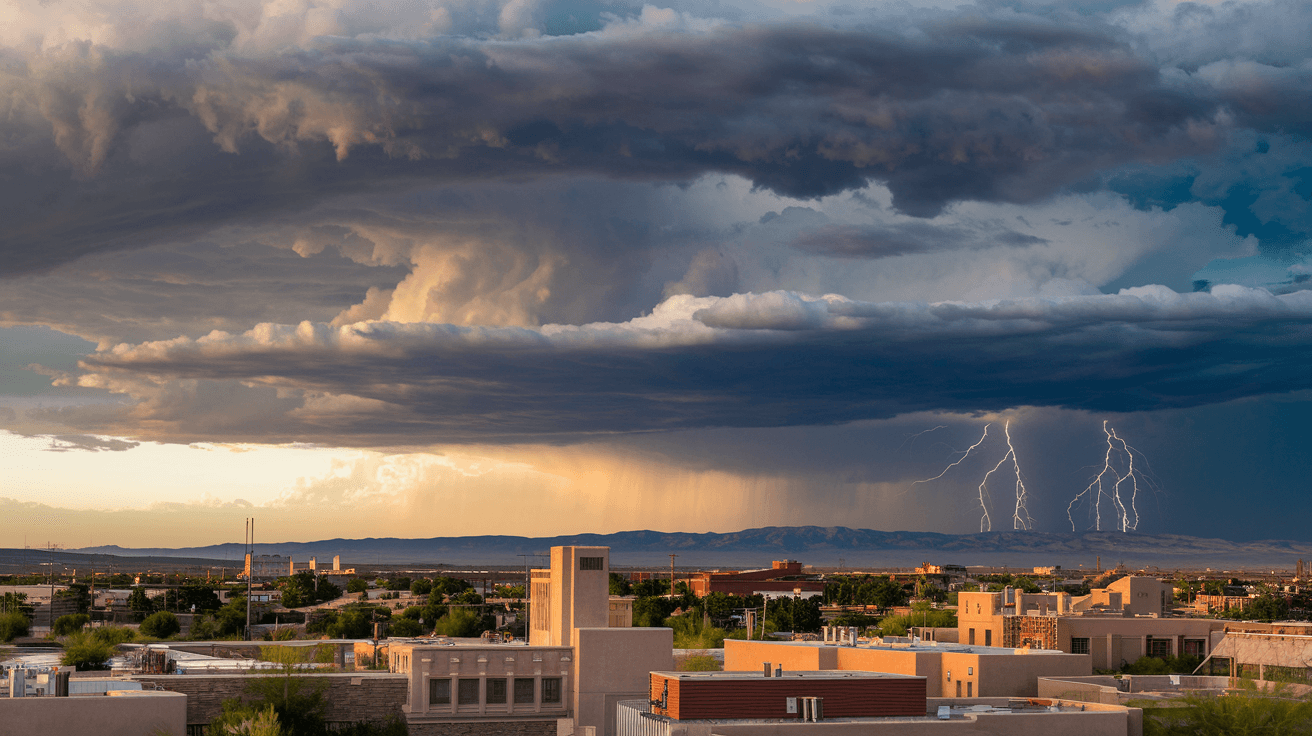
Summers are warm but not Phoenix-brutal. July averages in the low 90s, and the elevation keeps overnight temperatures in the 60s, meaning you can sleep with the windows open on most summer nights — something Phoenix residents have not experienced in July in decades. The trade-off is monsoon season, which runs roughly July through mid-September. The North American Monsoon delivers afternoon and evening thunderstorms, some of them genuinely dramatic with lightning, flash flooding in arroyos, and brief but intense rain. Flash flood warnings are real here. Do not drive into flooded washes. The monsoon also brings relief from the early summer heat and turns the high desert green in a way that surprises first-time visitors.
Spring is genuinely unpleasant for about six weeks. March and April bring sustained wind — not a gentle breeze, but 40 to 50 mph gusts that scour the mesa and fill your house with fine yellow dust if you leave a window cracked. Longtime residents either love the drama of spring wind or have learned to tolerate it. New arrivals consistently underestimate it.
Neighborhoods by Lifestyle
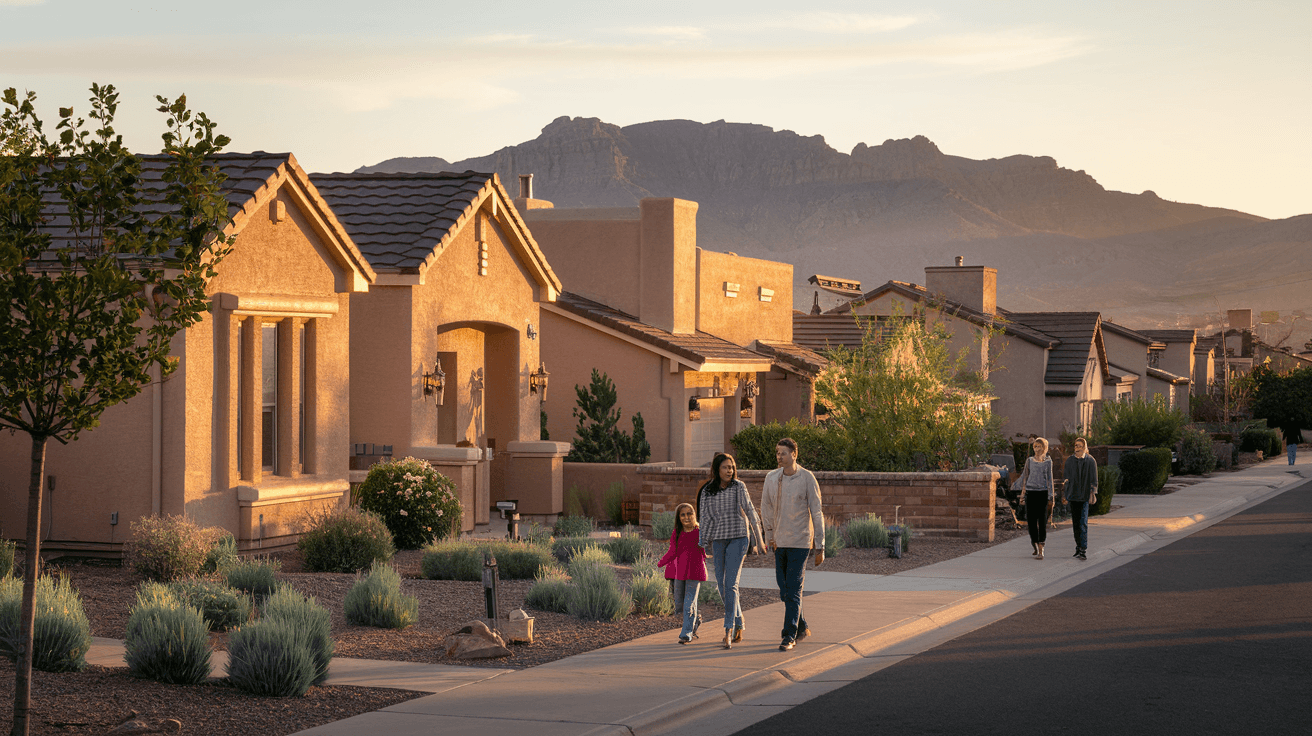
Albuquerque is not a monolithic city. It is a collection of distinct communities, each with a different character, price point, and daily rhythm. Where you choose to live shapes your experience more than almost any other decision.
Urban Living: Downtown and Nob Hill
Downtown Albuquerque — centered around Central Avenue, 4th Street, and the historic Old Town area — is the city's most walkable core. The EDo (East Downtown) arts district along Coal and Gold Avenues has emerged as a legitimate restaurant and gallery scene. The Albuquerque BioPark, the Albuquerque Museum, and the Indian Pueblo Cultural Center are all within a few minutes. Housing here is a mix of historic adobes, mid-century apartments, and newer infill condos. Prices for single-family homes in the near-Downtown area range from $250,000 to $450,000 depending on condition and exact location.
Nob Hill, stretching along Central Avenue between Girard and Washington, is the city's most walkable neighborhood and arguably its most desirable urban address. The retail strip on Central is a mix of independent restaurants — Zinc, Flying Star, Thai Vegan, the Brew, Canteen Brewhouse — and bars that serve a mixed crowd of UNM faculty, young professionals, and longtime residents. Housing is dominated by 1940s and 1950s bungalows and Pueblo Revival homes. The median price in Nob Hill runs around $430,000, and homes here move fast — typically under 20 days on market when priced correctly.
Suburban Living: Northeast Heights and Taylor Ranch
The Northeast Heights is where the majority of Albuquerque's middle and upper-middle class families live, and for good reason. The area — roughly bounded by Paseo del Norte to the north, Tramway to the east, Montgomery to the south, and Louisiana to the west — offers some of the city's best schools, easy freeway access to Sandia Labs and Kirtland, and a range of housing options from 1970s ranch homes at $280,000 to newer construction closer to the foothills at $600,000 and above.
The Foothills submarket, along the base of the Sandias between Tramway and the Open Space boundary, commands the highest prices in the metro. Homes here offer direct access to hiking trails, dramatic mountain views, and larger lot sizes. Expect $500,000 to over a million for well-appointed properties in this zone.
Taylor Ranch, on the West Side off Coors Boulevard north of Paseo del Norte, offers newer housing stock at lower price points than the Northeast Heights. Families with younger children are drawn here by the more affordable entry point — median prices in the high $200,000s to mid-$300,000s — and the proximity to shopping at Cottonwood Mall.
Rural and Semi-Rural: North Valley, Corrales, and Placitas
For buyers who want land, animals, and a slower pace, three communities stand out.
The North Valley runs along the Rio Grande between Alameda and the Downtown area, inside city limits but feeling like a completely different world. Properties here sit on quarter-acre to multi-acre lots along acequias (irrigation ditches), with cottonwood bosque at the river's edge. Horses, chickens, and vegetable gardens are the norm. Prices range from $350,000 to well over $1 million depending on lot size, condition, and proximity to the river.
Corrales is an incorporated village north of Albuquerque's city limits, accessible via Corrales Road off Coors Boulevard. It is the most sought-after rural address in the metro — agricultural zoning, large lots (most over half an acre), a village center with the Casa Vieja restaurant and the historic church, and a tight-knit community that fiercely protects its rural character. The median price in Corrales is approximately $650,000, and good properties here sell quickly to buyers who know what they want.
Placitas sits in the Sandia Mountains foothills north of the city, off Highway 165 past the I-25/Bernalillo exit. Homes here sit on 1- to 5-acre lots with dramatic high-desert views, no city services, and a drive to Albuquerque amenities that runs 25 to 45 minutes depending on your destination. It attracts a specific buyer: someone who prioritizes land, privacy, and the particular silence of the high desert over urban convenience.
Schools: APS vs. Rio Rancho vs. Private
Albuquerque Public Schools (APS) is the third-largest school district in the Southwest and, like most large urban districts, highly variable in quality. The best schools in APS are genuinely excellent — Manzano High School on the East Side, La Cueva High School in the Northeast Heights, and Cibola High School on the West Side all have strong academic programs, competitive athletics, and active parent communities. Where you live within APS determines your assigned school, and the difference between schools on the East Side and schools in some lower-income central neighborhoods is significant. Ask me to pull school ratings for specific addresses before you make a buying decision.
Rio Rancho Public Schools (RRPS) consistently outperforms APS on state assessments and has benefited from the city's newer, more affluent demographic profile. If schools are your primary criterion and you are open to Rio Rancho, the school district alone is a compelling argument.
Private school options are solid. Albuquerque Academy, near the foothills on Wyoming Boulevard, is the metro's most prestigious private school and draws applications from across the city. Rio Grande School and Bosque School serve the K-8 and elementary markets. Sandia Preparatory School is another strong option for families seeking alternatives to APS.
Culture and Community
Albuquerque's cultural identity is genuinely distinct, and it takes new arrivals a little time to understand it. This is not a Southwestern theme park — it is a real city with a 300-year history, a significant Native American and Hispano cultural presence, and an arts scene that punches well above its weight class.
The Indian Pueblo Cultural Center on 12th Street NW is one of the best museums in the Southwest, operated by the 19 Pueblos of New Mexico. The Albuquerque Museum in Old Town has a superb collection of Southwestern and New Mexico art. The National Hispanic Cultural Center on 4th Street SW is a world-class facility for Hispano arts and culture.
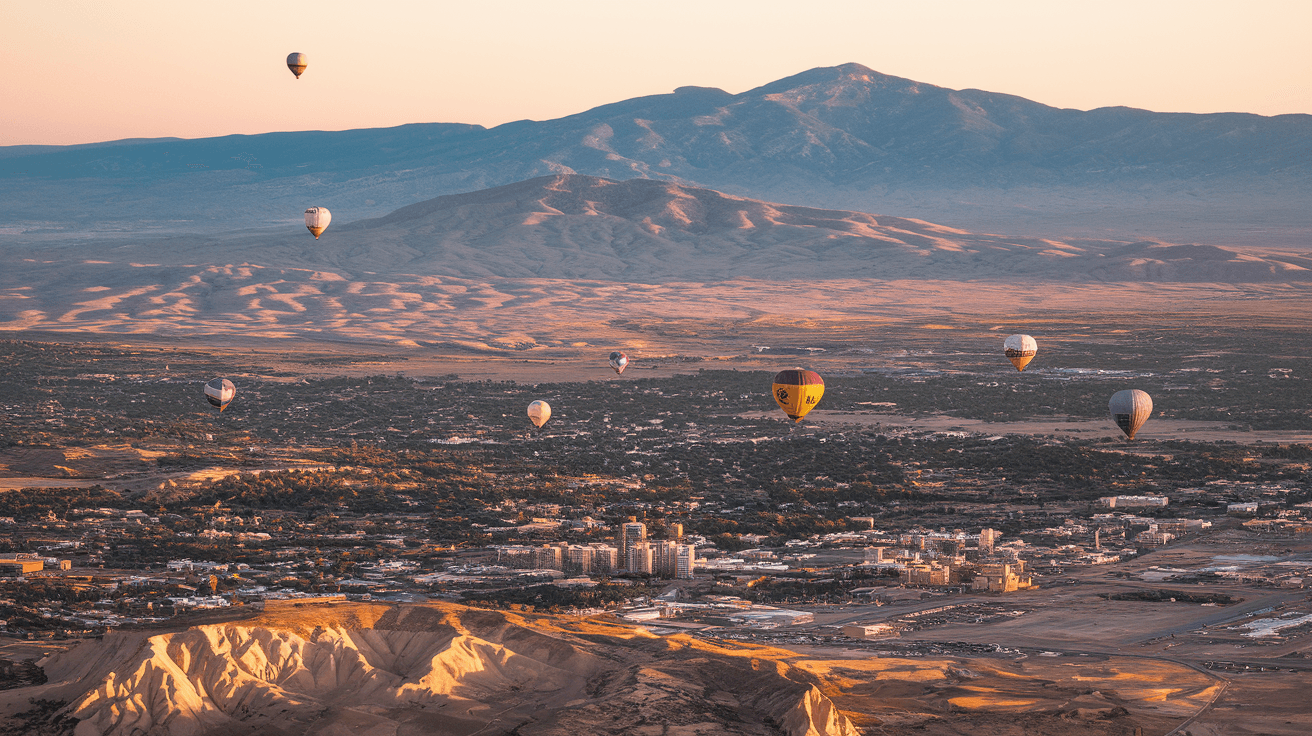
The International Balloon Fiesta in October is genuinely one of the world's great spectacles — roughly 500 balloons launching at dawn from Balloon Fiesta Park, with the Sandias as a backdrop. If you live in Albuquerque, you stop resenting the traffic and start inviting out-of-town guests just for the excuse to go every year.
Route 66 runs through the heart of Albuquerque as Central Avenue, and the neon sign culture, the vintage motels, and the roadside architecture are still very much present between Old Town and Nob Hill. The Albuquerque section of Route 66 is one of the most intact in the country.
The food culture is its own category. New Mexico cuisine — green chile, red chile, posole, sopapillas, green chile cheeseburgers — is not Tex-Mex and not Mexican. It is its own thing, built over centuries, and you will either fall completely in love with it or you will be confused for the first six months. Most people fall in love with it. Duran's Pharmacy on Central for the tortillas. Frontier Restaurant near UNM for the green chile stew and the sweet rolls at 1 a.m. Sadie's on 4th Street for the combination plates. El Modelo on 2nd Street for the tamales.
“A note from someone who has helped hundreds of people make this move: the biggest adjustment is not the heat, the altitude, or the wind. It is learning to slow down. Albuquerque operates on its own timeline. The pace is unhurried in ways that feel foreign if you are coming from Austin or Denver. Give it six months. Most people stop fighting it and start appreciating it. The ones who never adjust usually came expecting a different city. Come expecting Albuquerque and you will likely stay longer than you planned.
Practical Notes for the Move
A few things I wish I could tell every relocation client before they arrive:
Altitude matters. At 5,312 feet, you will feel it the first few weeks — headaches, faster intoxication, dehydration. Drink more water than you think you need. Give yourself a month before you judge how you feel about the place physically.
Sunscreen is non-negotiable. The elevation plus 310 sunny days means UV exposure here is significantly higher than at sea level. This is not optional advice.
A car is essential. Albuquerque has a bus system (ABQ Ride) and the Rail Runner commuter train connects to Santa Fe, but the city is fundamentally car-dependent. Very few people live car-free here outside of the immediate Nob Hill/UNM corridor.
The real estate market moves fast in desirable neighborhoods. The Northeast Heights foothills, Nob Hill, and Corrales regularly see multiple-offer situations on well-priced properties. Come prepared with pre-approval in hand and a clear sense of what you want, because hesitating for a week on a good listing often means losing it.
If you are seriously considering the move, reach out. I can walk you through neighborhoods in detail, pull market data for specific zip codes, and connect you with trusted relocation attorneys, mortgage lenders, and moving companies who know this market. This city rewards people who arrive informed.
Want more insider intel?
Subscribe to get market updates and new articles delivered to your inbox.